

The question when to change a running shoe comes up a lot? For me, it’s the right time, and the new shoes are the same as the old ones, so it’s easy to compare the differences. Visible changes are on the used shoes and the really important changes, why it is very important to replace your running shoes are invisible. Or are they?
Let’s start with the data. We’ve already reviewed the Hoka Arahi 6 running shoes, it’s worth a read. I have run 650 km in my current Arahi 6 and started using it 1 year ago. I use 3 other shoes in rotation, a Salamon S/Lab ultra 3 for cross country, an Asics Magic Speed for fast training races, and an Asics Novobalst 3 for interval or slightly faster paced training. I use the Hoka Arahi 6 for slow runs and mileage. I really like it because it’s light, comfortable, and bouncy enough that I don’t get tired on longer runs. I have also run marathons in them.
The 650 km of use (and 1 year) may not seem like a lot, and many may wonder why I replaced it so soon. On the one hand, the answer to this question will be clear by the end of this article, and on the other hand, I’m not replacing it, I’ll use it for shorter runs.
As I mentioned, the major changes that made the replacement of the running shoes due are not visible, but let’s start with the visible signs:
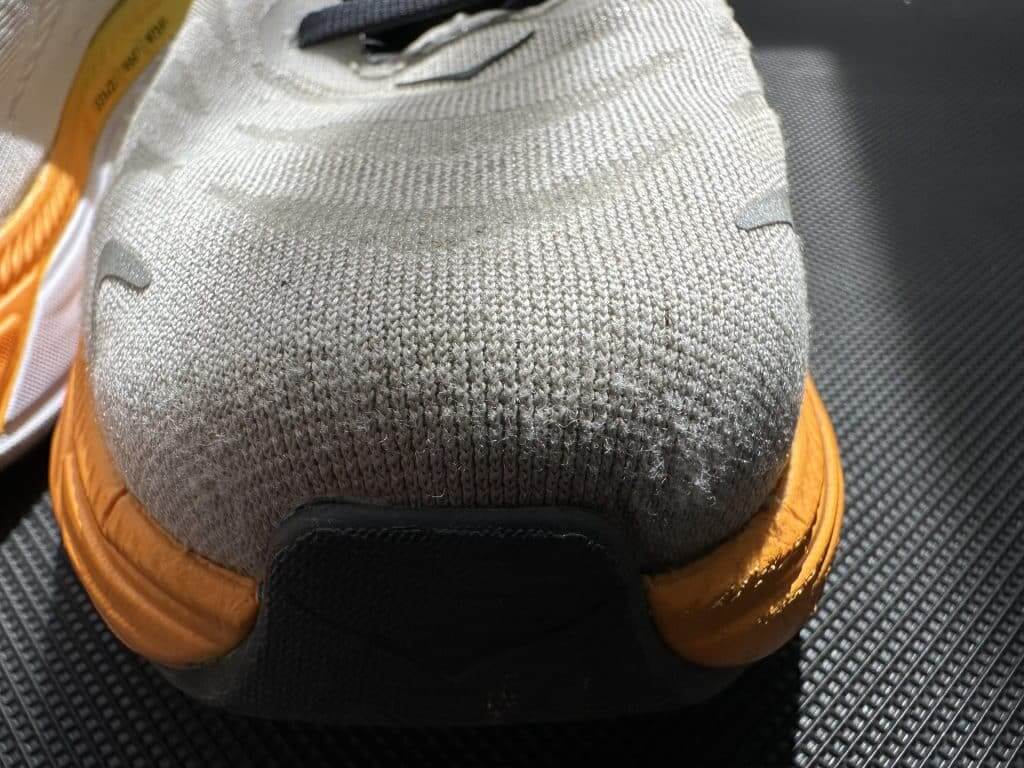
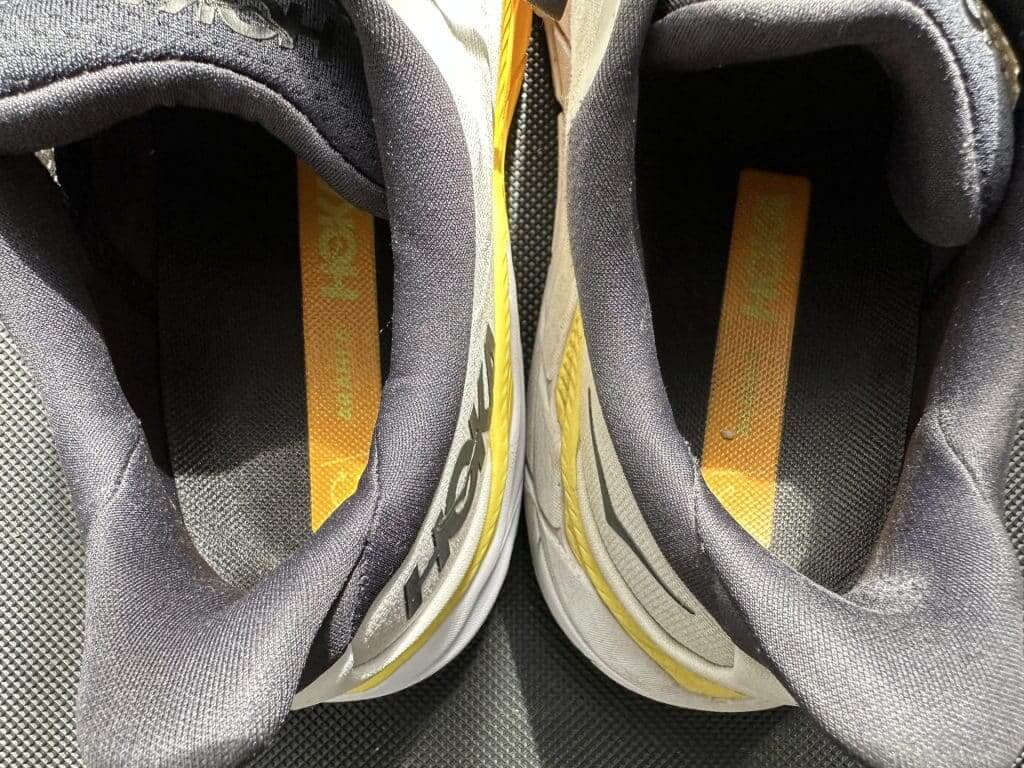
The upper of the shoe is perfect. I didn’t spare it and it’s still perfectly fine, it’s a little bit fuzzy, but there’s no major wear on the outside or inside (heel collar, heel under sole).
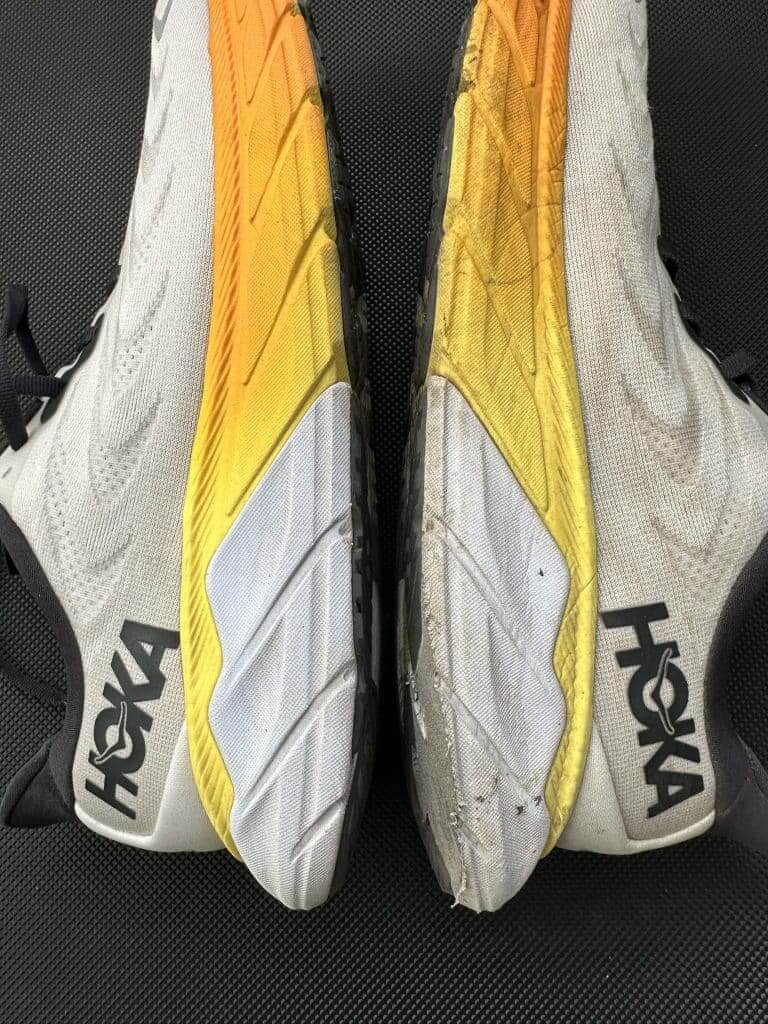
There are a few noticeable wrinkles on the midfoot, but that doesn’t seem too bad either.
On the outer foot, however, there is already considerable wear. It would be worth a separate post to analyse what can be inferred from the pattern of the wear, but that’s not what this post is about. Since I used the Hoka Arahi 6 for slower and longer runs, the slower pace meant I tended to land on the heel and the longer distances meant that fatigue also tended to load the heel more.

At around 350 km on the heel, the outsole wore out and the midsole started to wear out. However, it is clear that the extent of the outsole wear is not so great that it has significantly affected the grip of the shoe, and it did not feel particularly slippery (just as slippery as when new).
The less visible differences that make it worth replacing your running shoes
I measured the thickness of the sole of the shoe with a simple test. I put on the new one and drew a line between the edge of the shoe and the foot, then swapped shoes, put on the used one and measured the difference:
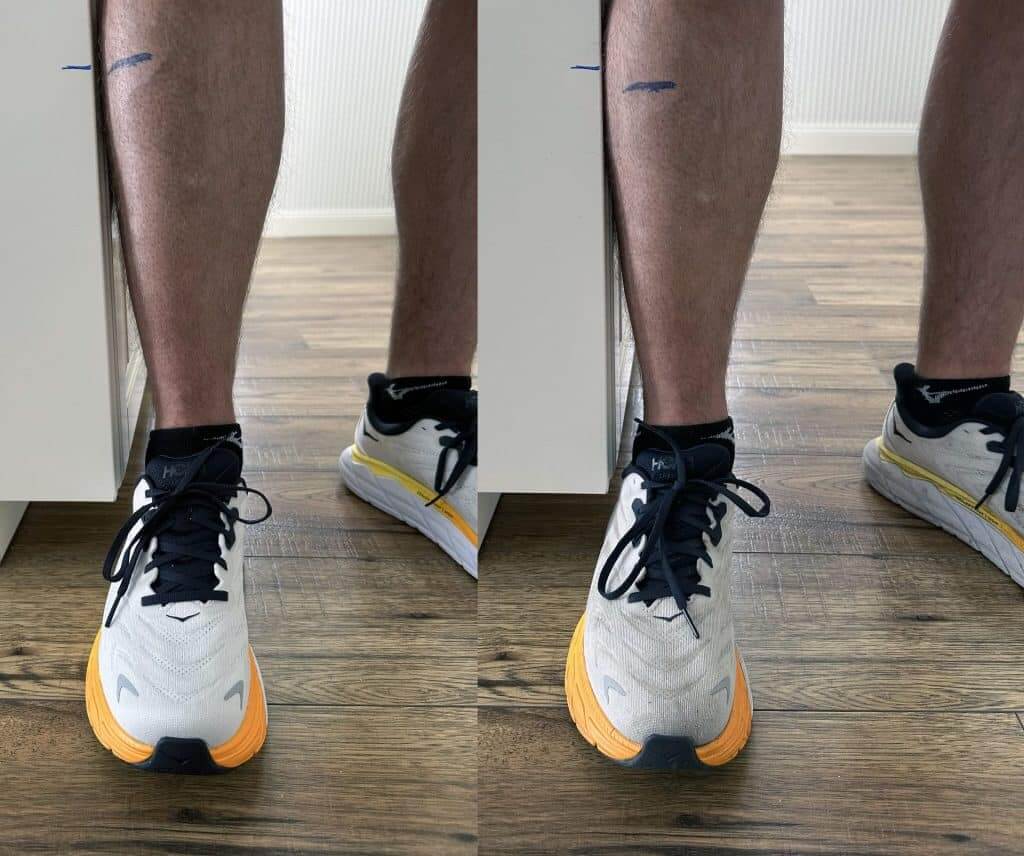
The view speaks for itself: the soles of used running shoes are a good 1 cm thinner than new ones. A few millimetres are due to wear on the outsole (wear on the heel does not contribute to the thickness because it is already on the flexing part, which does not touch the ground in a flat standing position), but most of the difference is due to the “shrinkage” of the outsole.
After 650 Km of running, the foam of the mid-sole has collapsed about 1 cm. This is a stable shoe, with a J-frame in the midsole that is not soft it doesn’t collapse easily, yet the midsole has shrunk that much.
The invisible changes that make it worth replacing a used running shoe
Before putting on the new shoes, I ran 15 km in the old ones at a pace of 5:30 (for me, this is the pace for easy, low-intensity runs, which is what I use the Arahi for). I waited two days to fully recover, then ran 15 km in the new one. There were a few complicating factors on the 2nd run (when I ran in the new shoes). For one thing, I ran in 27 degrees on a scorching sunny day, whereas the first was in a pleasant 20 degrees early in the morning, and I had a massive beer run between the two runs, so although I wasn’t hungover, I wasn’t rested either.
I could feel my knees in the old used shoes at the 10th km, and by the end my knees were a bit sore. I was exhausted, and towards the end I had to be careful to keep up the 5:30 pace. Even the next day I felt a bit sore here and there, I wasn’t very fresh.
In the new shoes, my knee didn’t hurt at all after the run (even though I put 2 km on it, so I ran a total of 17 km in them). The run didn’t seem that tiring, I had to be careful not to overrun, even in the last km, if I wasn’t careful I would easily switch to a pace around 5-5:10. It was flexible, the shoe asked for pace, it felt good to run in. The next day I was rested, not sore and felt fully prepared for another run.
More experienced runners would probably ask me now how much I weigh, and it’s a fair question because the weight of the runner plays a big part in the wear and tear. I weigh 63kg, which I don’t think is much for a male runner.
The lesson is that it is worth starting to use your new running shoes for longer runs before you take them off. Unfortunately, I can tell you from experience that running shoes that are used for too long can cause serious injuries in those who are prone to them or those who run with less than perfect running technique.
Before anyone gets the wrong idea, this article is not about how the Hoka Arahi is not durable, because on the one hand that is not true, and on the other hand other manufacturers have durable and less durable running shoes. THE Arahi is a very good shoe, this is my third Arahi and I’m sure there will be a fourth. In fact, there are much more durable stable running shoes, such as the Asics Gel-Kayano, which is much more robust, but 50 grams heavier and costs exactly twice as much as the Arahi, although you can run in it about twice as much. I love Asics shoes (probably the most Asics running shoes I’ve ever had), I’m not speaking against Asics with the previous few lines, I just want to point out that it’s a matter of opinion which one you prefer. I need/needed a lightweight cheap stable running shoe for my easy runs, for which the Arahi is perfect, even if it wears out quickly.


